Laser Treatment vs Vein Stripping
How Two Very Different Procedures Treat the Same Problem
Both endovenous laser treatment (EVLT, also called EVLA) and traditional vein stripping exist to solve the same underlying issue — a leaking vein valve that’s letting blood flow backward instead of toward the heart. But the way each procedure gets there is fundamentally different, right down to the tools used, the setting the procedure happens in, and what recovery actually looks like day to day.
Laser Treatment vs Vein Stripping: Two Different Philosophies
Vein stripping works on a removal principle — the faulty vein is physically taken out of the leg. Once it’s gone, it obviously can’t leak anymore.
EVLT works on a closure principle — the vein is left in place but sealed shut from the inside, so blood simply stops flowing through it and gets rerouted through healthy neighboring veins instead. Over the following months, the body gradually reabsorbs the closed vein’s tissue on its own.
That difference in philosophy — take it out versus shut it down — is what drives almost every other difference between the two procedures.
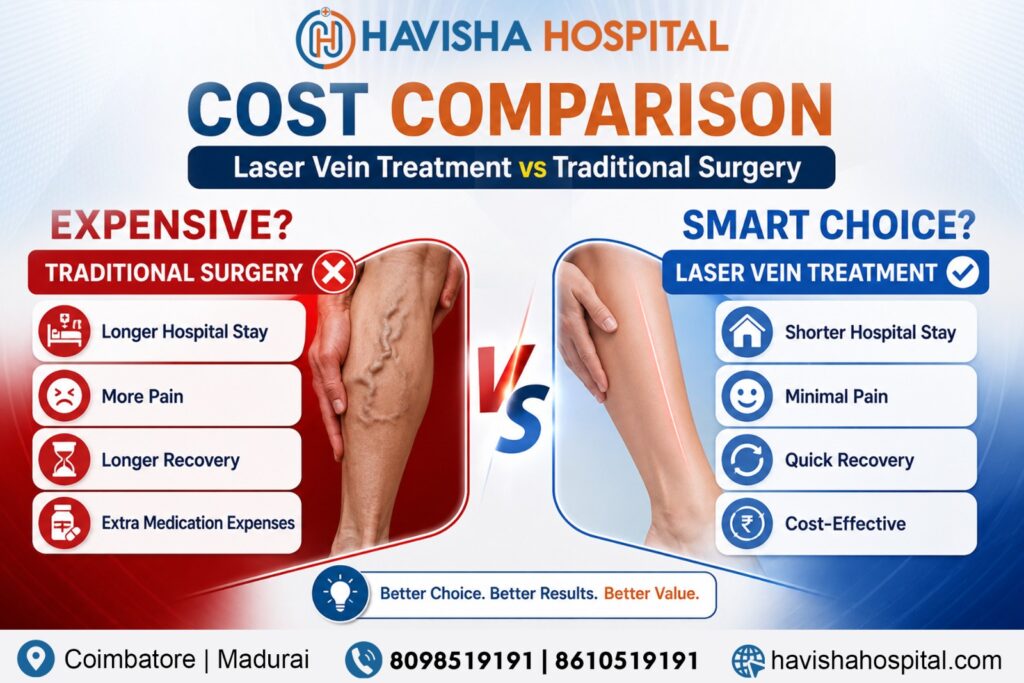
Vein stripping is a surgical procedure, typically performed under general or spinal anesthesia in an operating theatre. It’s built around two separate steps:
High ligation comes first. The surgeon makes an incision near the groin (for the great saphenous vein) or behind the knee (for the short saphenous vein) to expose the point where the diseased vein joins the deep venous system. The vein is tied off at this junction — this step alone prevents reflux from re-entering the vein from above.
Stripping follows. A thin, flexible wire or stripping device is threaded down the full length of the diseased vein, from the groin incision to a second incision made further down the leg, usually near the knee or ankle. The vein is then pulled out through one of the incisions — a technique called invagination stripping is commonly used, where the vein is essentially turned inside out as it’s withdrawn, which reduces bleeding and tissue trauma compared to older stripping methods.
Any smaller bulging tributary veins branching off the main vein are usually removed separately through a series of tiny incisions along the leg, a step called ambulatory phlebectomy — often done in the same session.
How Endovenous Laser Treatment (EVLT/EVLA) Actually Works
EVLT takes an entirely different mechanical approach and is performed under local tumescent anesthesia rather than general anesthesia.
The procedure starts with a single needle puncture into the diseased vein, usually near the knee or ankle, guided in real time by ultrasound imaging so the physician can see exactly where the needle tip is relative to the vein wall. A thin catheter is threaded through this puncture point up the length of the vein to the point near the groin or knee where it joins the deeper venous system.
Before activating the laser, a diluted local anesthetic solution — the “tumescent” fluid — is injected around the entire length of the vein under ultrasound guidance. This does three jobs at once: it numbs the vein and surrounding tissue, it compresses the vein around the laser fiber for more even energy contact, and it creates a fluid buffer that protects nearby skin and nerves from heat.
A laser fiber is then passed through the catheter to the top of the vein. As the physician slowly withdraws the fiber — a controlled pullback, typically a few millimeters at a time — pulses of laser energy heat the vein wall from the inside. That heat damages the inner lining of the vein, causing it to contract and its collagen to denature, which triggers the vein to close and eventually scar shut along its entire length. No vein is removed; it’s sealed in place.
The Experience During the Procedure
This is where the two approaches diverge most sharply for the patient.
With vein stripping, the patient is under general or spinal anesthesia and is unconscious or numb from the waist down for the entire procedure, which typically takes place in a hospital operating theatre. There’s no awareness of the procedure itself, but there’s also the standard preparation and recovery associated with general anesthesia — pre-operative fasting, IV lines, and monitored recovery time before discharge.
With EVLT, the patient is awake throughout. Because the anesthesia is local, there’s ongoing communication between the patient and physician during the procedure, and most patients describe the sensation as pressure or mild warmth along the leg rather than pain. There’s no fasting requirement, no IV sedation, and patients typically walk into the procedure room and walk out of it under their own power shortly after.
Immediate Post-Procedure Differences
Right after the procedure, the visible difference is significant.
Vein stripping leaves two or more surgical incisions (plus additional small phlebectomy incisions if tributaries were removed), which need sutures or surgical glue and produce more noticeable bruising along the path where the vein was physically pulled out. Some swelling and tenderness along that entire path is expected in the first few days, and pain relief medication is typically needed for longer than with a closure procedure, since actual tissue has been removed rather than just heated.
EVLT leaves a single small puncture mark, closed with nothing more than a plaster or steri-strip, since no incision was made. Bruising is usually limited and follows the treated vein as a thin line rather than a wide surgical field, because the trauma is thermal rather than mechanical. Most patients feel a pulling or tight sensation along the treated vein for the first few days rather than sharp pain.
How the Recovery Timelines Differ
The underlying difference in tissue trauma — a vein physically removed versus a vein sealed shut in place — is what drives the recovery gap.
After vein stripping, walking is encouraged from the first day to reduce clot risk, but return to normal daily activity generally takes longer, and more strenuous activity is typically restricted for several weeks while the surgical incisions fully heal. Compression stockings are worn for an extended period afterward to control swelling and support the leg while the incision sites close.
After EVLT, most patients resume normal daily activity within a day or two, since there’s no surgical wound to protect — only a puncture site. Compression stockings are still recommended for a period afterward, primarily to help the treated vein close down evenly and reduce bruising, rather than to protect a healing incision. Because the leg wasn’t mechanically opened up, the discomfort curve during recovery tends to be flatter and shorter.
Why the Two Procedures Can Fail Differently
Both procedures can, in a minority of cases, fail to fully resolve reflux — but the mechanism behind recurrence is different for each, which is a technical distinction worth understanding.
With vein stripping, one recognized cause of recurrence is neovascularization — the body’s tendency to regrow small new blood vessels around the site where the vein was ligated and removed, effectively rebuilding a pathway for reflux to re-enter the system near the original junction.
With EVLT, recurrence is more commonly linked to recanalization — a segment of the treated vein that wasn’t fully sealed along its length reopens and allows blood flow to resume — or to reflux developing in a different vein that wasn’t part of the original treatment. Because EVLT is a segmental, catheter-based treatment, its outcome depends heavily on complete, even energy delivery along the full length of the vein, which is one reason ultrasound guidance is used throughout rather than only at the start.
Book a consultation with Havisha Hospital’s vein care team in Coimbatore or Madurai:
+91 86105 19191
Blog Posts
Frequently Asked Questions
Vein stripping is still performed, but far less often than it used to be. Most professional vascular societies now recommend catheter-based closure techniques like EVLT as the first-line option, reserving surgical stripping for specific anatomy that isn’t well suited to a catheter approach.
Extremely tortuous (sharply curved) veins can make it difficult to pass a catheter and laser fiber along the full length smoothly, which is one scenario where surgical removal may be technically more straightforward than a catheter-based approach. Vein diameter alone is less of a limiting factor than the degree of tortuosity.
No. EVLT relies entirely on heat-induced closure along the vein’s length rather than a ligation step at the junction with the deep venous system. This is a genuine mechanical difference between the two approaches, not just a difference in access technique.
Stripping involves cutting into tissue at two separate incision sites and physically pulling the vein out, which requires a deeper level of anesthesia to manage the associated tissue trauma. EVLT’s tumescent fluid numbs the vein and surrounding tissue directly at the treatment site, which is sufficient because no incision or tissue removal is involved.
Both procedures carry some risk of temporary nerve irritation, since sensory nerves often run close to the treated veins, particularly near the ankle and knee. With stripping, this risk is tied to the mechanical pulling of the vein past the nerve; with EVLT, the tumescent fluid injected around the vein is specifically intended to create a buffer that reduces this risk from heat.
This varies by case and is determined by the treating physician based on how the leg is healing, but the underlying reason for the difference is structural: stripping requires the compression period to support healing surgical incisions, while EVLT requires it mainly to help the vein seal down evenly, so the two serve different purposes even when the stocking itself looks the same.
Contact us
For more details
📍 Locations
Singanallur, Coimbatore, Tamil Nadu 641005
Tallakulam, Madurai, Tamil Nadu 625002
📞 Phone Numbers
+91 80985 19191
+91 86105 19191
🌐 Website
Book Your Consultation with Dr. Hari Hara Jothi Today
If you have been living with painful, swollen, or visible varicose veins — relief is closer than you think. Dr. Hari Hara Jothi offers expert, personalised, and minimally invasive varicose vein treatment in Coimbatore that fits your life.
Do not wait for a simple vein problem to become a serious complication.
Subscribe to Our Newsletter
Get expert tips on varicose vein treatment, vascular care, and the latest health updates from Havisha Hospital in Coimbatore & Madurai.

Havisha Hospital delivers advanced, patient-focused care with a commitment to safety, comfort, and faster recovery in Coimbatore and Madurai.
Treatments
Information
Phone Number
+91 86105 19191
Maill Address
havishahospital@gmail.com
Head Office
Singanallur, Coimbatore, Tamil Nadu 641005.
Tallakulam, Madurai Tamil Nadu 625002.